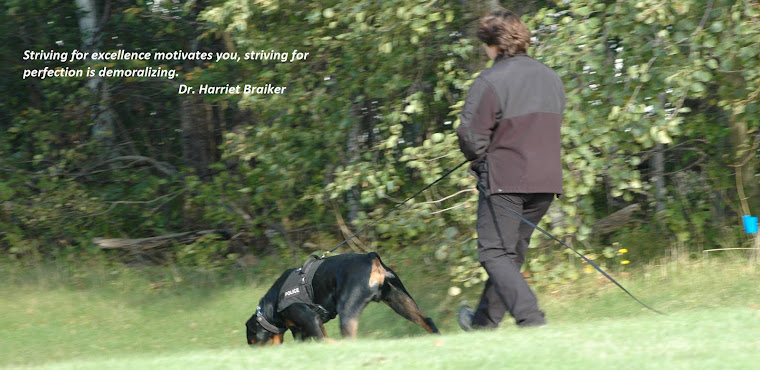
In the course of teaching a lot of different types of dog training course; whether for sport or work, I find myself making the same observations. A big one is that trainers of all types get way to hung up on the mechanics of a task. Take police k9 detection tasks; something that I am teaching at the moment. I could take a clicker and a handful of treats and teach a great many dogs to nose touch an odor and then sit. However I need a dog that will do all of the above in the presence of a massive amount of distraction, when he is tired, when his handler is distracted, when it is in a place where it has never been in training. For that I need a dog that not only understands the correct exercise but also has the right attitude. In the course of my travels lately I have seen a lot of examples of where the trainer or handler was "winning the battle" and getting a certain behavior but "losing the war" by detracting from the dogs enthusiasm or understanding.
Two more weeks of detection training in the Washington DC area. We have worked with a large group of really fun, highly motivated police k9 trainers. Dogs have been excellent too.
Monday, March 11, 2013
Monday, March 4, 2013
A New Training Project
As if traveling the country helping to teach detection trainer's course and training my own four dogs; including a 6 month old puppy, wasn't enough - I have added a new training project. I was asked to join Denise Fenzi's new project, an online dog sports academy.
I am going to offering a variety of on line tracking classes. At first I had some misgivings about teaching tracking in such a format. It is challenging enough as it is. However I gave it some thought and I m looking forward to tackling the challenge. I put together my list of courses last night and it was a challenge to break the skills down into individual courses. I generally try to teach my green/young dogs some of the more advanced skills right from the start. I am careful not to over challenge them but I also want to take advantage of the fact that they don't know that something is an advanced skill yet. They are too new to the task to make assumptions - such as "tracks are always on grass". I will try to do a little of that in the classes but most likely less than I do with my own dogs.
Six month old malinois learning that he can track on asphalt as well as grass. It isn't pretty yet but I accomplished my training goals of showing him that tracking is tracking; it has nothing to do with what surface the track is on. You can see at first that he thinks this is an attention exercise. As he gains experience the harness will help him determine the difference. I laid the track in my sock feet so as to help him have some extra scent to follow (don't laugh; I laid a big chunk of Steel's VST tracks in my sock feet). I didn't want to lay food on the track but I also wanted to reinforce the track a bit so you can see me tossing food out in front of us. My only goal at this point was to reinforce a behavior of him sticking his nose to the track. He cant help but smell the track while he is getting reinforced. I have a few additional techniques to develop his hard surface tracking but this worked okay for the first time.
Friday, February 15, 2013
Where Am ?!
We are back to traveling again. So far I have not had any disorienting moments like I had last year when I had a brief moment where I could not remember where I was. As in what state am I in?? Who knew the life of a dog trainer could so closely resemble that of a traveling musician??
Anyhow, several people have asked me where I am going to be and about my availability for private training and clinics . This seemed to be the easiest way to answer them all in one place. Traveling quite a bit for work with scent detection schools and seminars but I do have some time available for teaching. Training available includes tracking (private or clinics), detection, performance coaching/problem solving (privates) or help working with reactive dogs (privates).
Those who are interested can contact me at: LAN5@SOVER.NET.
My current 2013 schedule:
February 4 - 25 Maryland
Detection Trainers Course; law enforcement
February 24 - March 01 North Carolina & South Carolina
private training classes
March 04 - March 22 eastern Virginia
Detection Trainers Course; law enforcement
March 25 - March 30 western Virginia
private training classes
April 08 - 11 St Louis MO
Working Dog Conference
April 15 - May 03 Indiana
Detection Trainers Course
May 06 - 24 Illinois
Detection Trainers Course
June 03 - June 21 Illinois
Detection Trainers Course
June 25-27 Colorado
Detection Trainers Seminar
July 12-14 Wyoming
Tracking/Trailing Seminar
Sept 06 - 08 Michigan
Detection Trainers Seminar
Anyhow, several people have asked me where I am going to be and about my availability for private training and clinics . This seemed to be the easiest way to answer them all in one place. Traveling quite a bit for work with scent detection schools and seminars but I do have some time available for teaching. Training available includes tracking (private or clinics), detection, performance coaching/problem solving (privates) or help working with reactive dogs (privates).
Those who are interested can contact me at: LAN5@SOVER.NET.
My current 2013 schedule:
February 4 - 25 Maryland
Detection Trainers Course; law enforcement
February 24 - March 01 North Carolina & South Carolina
private training classes
March 04 - March 22 eastern Virginia
Detection Trainers Course; law enforcement
March 25 - March 30 western Virginia
private training classes
April 08 - 11 St Louis MO
Working Dog Conference
April 15 - May 03 Indiana
Detection Trainers Course
May 06 - 24 Illinois
Detection Trainers Course
June 03 - June 21 Illinois
Detection Trainers Course
June 25-27 Colorado
Detection Trainers Seminar
July 12-14 Wyoming
Tracking/Trailing Seminar
Sept 06 - 08 Michigan
Detection Trainers Seminar
Sunday, February 3, 2013
Signposts
I wrote this post last weekend while at a dog show in LA. Now I am in MD by way of SC.....I am starting to feel like my own "where's waldo" picture....
I have talked in previous posts about how exceptionally observant our dogs are. This is one of the things that makes them great; they have an outstanding ability to notice things and to mark those behaviors/items/ actions that result in reinforcement. Unfortunately they also notice the things that lead to bad consequences as well as good ones. And once those "signposts" are in place they are hard to eliminate; especially when they tell the dog how he should feel rather than act. When I try to explain what I mean by this I find it effective to use a great experience of my own.
When I attended the basic training school at the police academy we were required to be at the Academy from Monday morning to Friday afternoon. Our training was military like in its instruction and the first couple of weeks were designed to apply a significant amount of stress on the recruits. There were several reasons for this; one being to weed out the ones who could not function well under stress. Those people were obviously not cut out for law enforcement. Our instructors were very gifted at finding ways to apply stress to almost every aspect of our daily routine and whatever your weakness (be it physical or mental) they were going to find it.
The road leading to the Academy grounds went through a pair of tall stone pillars and up a long steep hill. Every Monday morning I would drive through the gate and upon passing through the pillars and heading up the hill my stomach would drop and I would feel slightly nauseous. Friday afternoon seemed to be an eternity away. Years later, having long since graduated from the basic class, I would routinely return to the Academy for in service training. This was not at all unpleasant, usually interesting classes and we were treated like the professionals that we were. Then I began returning to the academy for police canine training. Something very enjoyable with no stress involved at all. However every time I passed through those pillars I had a sinking feeling in my stomach and would feel nauseous for a second. There was no current cause of it, it was just a firmly developed signpost in my brain that signified upcoming stress and pressure.
Transfer this to training a dog for an exercise with potential for confusion. There are so many potential examples but I will use the scent discrimination exercise since I was talking about it in a recent blog post. This exercise involves using a bag of metal and leather obstacles - people usually keep these in a canvas and mesh bag and in order to avoid handling them they are dumped out from the bag. Thus a distinctive metal article rattling sound. This is a relatively simple exercise for the dog; however people sometimes inadvertently create confusion due to the manner that they teach it. I wonder for how many dogs, even ones who have learned the exercise well, is that sound a signpost for potential stress and pressure.
We need to be very careful in our training to avoid creating signposts to the dog that tell them unpleasant things are likely to happen. I am not talking in this case regarding compulsion or punishment but rather signposts that tell the dog about how the environment is likely to feel. I am at a dog show today so those examples are more obvious but they occur in all aspects of our training, regardless of what we are teaching the dog to do.
How about this for an example of a signpost with lots of clue to the dog that no reinforcement is going to happen for the dog:
there are lots of strange dogs around
there are large square areas with mats and bounded by white gates
handler is breathing faster
handler is talking to me less
handler is focusing on another person nearby
there is no reward upon completion of an exercise
(in training no rewards usually means incorrect behavior)
Tuesday, January 22, 2013
Brag for a friend....
This is "ELY"
V Rated Multi BISS Am/Can/UKC Ch. ATCH Esmonds Qruzin for a Bruzin CD Am/Can RN Ag.N Ag.NJ AD RAMCL TT HIC CGN
He is a very sweet boy but just a tad, shall we say, stubborn.....
When he was uncertain how to behave in a certain situation he (like many men) would go to his default - "jackass mode"....
Ely is big - muscles upon muscles. Him being a jackass is hard to miss...
Lucky for him he has an owner who is just as stubborn...
She had her ups and downs with him.
I think there was some serious consideration of toilet training him and hiding him in the basement.....
Most people would have quit. But not Cassie....
![]() |
| P.S. Red ribbons are FIRST places in Canada. Weirdos.... |
I can't say how proud I am of them and how delighted I am to have had a very small part in helping them accomplish great things. It is quite easy to give advice but much harder to take it and put in the time and hard work needed.
Cassie's recent Facebook post:
Well isn't THIS a happy way to end my week! Just saw the Rottweiler Club of Canada stats for 2011 and it's official that Ely finished #1 OVERALL ROTTWEILER for 2011 (combined obedience and conformation). Ely is my first, home-bred, home-raised, hand-picked puppy. I believed in this little guy from the moment he first landed in my hands. I mean, we had some very big challenges we worked through and... I had lots of days that ended with me not sure that we would ever continue to work towards our competitive obedience goals. But I stuck with him and we just kept on trucking. The conformation wins were sweet, but his CD was the absolute best title I have ever earned with a dog. His wicked scores made it almost unbelievable for me. Now to see my "naughty boy" at the top of that list, well, it (almost) leaves me speechless. Thank you to all of those who encouraged me over the years to stick with him (Lucy Newton - especially you! John Mairs for letting him disrupt so many of your classes for years!) and huge thank you to Mike and Ann for working so hard with us in 2011 to help my special boy shine the way he did. Wow, what is THIS going to do for his ego?!?
Tuesday, January 15, 2013
Dogs Can Be So Literal…
I have been following a discussion/activity associated with a facebook group that I belong to. Numerous people are training the scent discrimination exercise with their dogs. Most are training the AKC competition obedience exercise; others are looking towards nosework or other competitions. For those that don’t know the exercise - this involves putting out a series of identical objects, one with the handler’s scent on it. The others are clean/unscented. The dog then must go to the group of items and select the one with his handler’s scent on it and bring it back. This is a simple exercise for the dog. It is the canine equivalent of me telling you to go pick the red crayon out of a pile of other colored crayons. The challenge comes in communicating the specifics of this task to the dog. There are some things that can go wrong in this communication process. In a recent FB post one person was having trouble switching the dog from the articles that they started with (a metal tin) to an actual official, AKC approved metal articles. While the dog was consistently working the exercise on the first item, his proficiency dropped off on the other.
I am stealing this person’s “problem” in order to take an opportunity to comment on something that I see in almost all phases of dog training. And I put the word “problem” in quotes because sometimes it is not really a problem but rather a normal process of learning. Whether or not it is easy or not to fix, it IS a sign of some miscommunication; however temporary. Often the dog and handler are not on the same page with the exercise. When I am teaching I quite often suggest that the trainer think about what would happen if they could ask the dog to write out a description of the task. I think the results would be eye opening. I could just see my first cadaver detection dog taking about a hour (and needing to get to get up for extra paper and to sharpen his pencil) to write his essay. He learned the task and had a successful career but I sure didn’t make it easy for him to figure out what I wanted. I am pretty sure my current narcotics detection dog would be able to quickly fit his response onto a 3 X 5 card with room to spare and then run outside to play!
The difference in the two is in my ability to better explain to the dog exactly what the exercise is. The smoother the process is; with as few extraneous pieces of information as possible, the better this works. Making learning faster and less stressful for both of us. However some things are part of the learning process, the dog makes initial assumptions and we quickly let him work through the process and correct his initial assumptions on his own. As a trainer, I find these “wrong behaviors” fascinating because they often show me how much the dog is thinking and quite often the dog flat out amazes me with his thought processes. I have to stop and go “Wow! I DID teach you that didn’t I?!” Then I rethink how I am training and exercise and hopefully become a better trainer.
Here is a simple easy example of what I am talking about. Years ago when I was teaching my young future patrol dog to go through the police academy’s obstacle course I left him in a stay and then directed him to go through one of the culvert tunnels. We normally did the course counter clockwise during certification tests so I had started him in that direction. I did this a couple of times, followed by much praise and enthusiasm for his skill. Then I set him up at the other end of the culvert, again in a stay, and directed him to “tunnel”. He immediately ran to the opposite end, went through the culvert in what he considered the correct direction and blasted out the end, anticipating yet another party. He was also clearly delighted with himself for solving such a complicated exercise! And yes he did get the party he so clearly felt he deserved. Followed by my taking steps to manipulate his environment (putting him closer to the culvert and standing near the entrance) so that he quickly discarded his very brief assumption that he gets rewarded for running through the culvert right to left.
Another more recent observation: my young Rottweiler had passed both his TD and TDX easily and we were prepping for his VST. He worked a very nice section of track across a parking lot and then he came up to an article placed right before the curb at the edge of the parking lot. He stopped, carefully picked up the metal object in his mouth, gently set it down in the nearby grass and then laid down to indicate it. It was my habit to usually place articles in the grass portions of the track. Being strong on articles, I knew he wouldn’t have an issue indicating them on the hard surfaces, but because he is so article driven I had seen signs of him starting to use his eyes to scan for them on hard surfaces. However he clearly showed me on that day how well he understood the whole picture of what I had been rewarding him for – “Momma is very happy when I find articles on the grass. Therefore I must put this here…” When he came up on the article below the curb, seeing nearby grass, he took pains to arrange everything to maximize his chances of being rewarded. In his case the proximity to the grass was a big factor but it was also eye opening to have him show me just how attentive to detail he was capable of being. That they are so attentive is what makes them so amazing. It is also what makes training challenging.
While some dogs are more “literal” than others they all notice stuff that we can’t even imagine would be important to their understanding of the exercise. Sometimes this is totally unavoidable and a normal process of their learning, likely the case with the dog having trouble transferring from one metal object to another. We just back up our criteria a little bit and let them work through the transition. He learns that we want the scented item, regardless of its shape or material. However many times, in both competition and working venues, we inadvertently allow them to continue to make assumptions that we are totally unaware of. Familiar containers in detection. Or items contaminated or overwhelmed with other scents. Or our body language or other prompts or cuing. I see this in all types of work and sports but it is especially common in scent or detection work. All we see is the dog getting it right – if we are not careful in how we train them to do the work they can get it right for reasons that have nothing to do with scenting or using their nose.
I am stealing this person’s “problem” in order to take an opportunity to comment on something that I see in almost all phases of dog training. And I put the word “problem” in quotes because sometimes it is not really a problem but rather a normal process of learning. Whether or not it is easy or not to fix, it IS a sign of some miscommunication; however temporary. Often the dog and handler are not on the same page with the exercise. When I am teaching I quite often suggest that the trainer think about what would happen if they could ask the dog to write out a description of the task. I think the results would be eye opening. I could just see my first cadaver detection dog taking about a hour (and needing to get to get up for extra paper and to sharpen his pencil) to write his essay. He learned the task and had a successful career but I sure didn’t make it easy for him to figure out what I wanted. I am pretty sure my current narcotics detection dog would be able to quickly fit his response onto a 3 X 5 card with room to spare and then run outside to play!
The difference in the two is in my ability to better explain to the dog exactly what the exercise is. The smoother the process is; with as few extraneous pieces of information as possible, the better this works. Making learning faster and less stressful for both of us. However some things are part of the learning process, the dog makes initial assumptions and we quickly let him work through the process and correct his initial assumptions on his own. As a trainer, I find these “wrong behaviors” fascinating because they often show me how much the dog is thinking and quite often the dog flat out amazes me with his thought processes. I have to stop and go “Wow! I DID teach you that didn’t I?!” Then I rethink how I am training and exercise and hopefully become a better trainer.
Here is a simple easy example of what I am talking about. Years ago when I was teaching my young future patrol dog to go through the police academy’s obstacle course I left him in a stay and then directed him to go through one of the culvert tunnels. We normally did the course counter clockwise during certification tests so I had started him in that direction. I did this a couple of times, followed by much praise and enthusiasm for his skill. Then I set him up at the other end of the culvert, again in a stay, and directed him to “tunnel”. He immediately ran to the opposite end, went through the culvert in what he considered the correct direction and blasted out the end, anticipating yet another party. He was also clearly delighted with himself for solving such a complicated exercise! And yes he did get the party he so clearly felt he deserved. Followed by my taking steps to manipulate his environment (putting him closer to the culvert and standing near the entrance) so that he quickly discarded his very brief assumption that he gets rewarded for running through the culvert right to left.
Another more recent observation: my young Rottweiler had passed both his TD and TDX easily and we were prepping for his VST. He worked a very nice section of track across a parking lot and then he came up to an article placed right before the curb at the edge of the parking lot. He stopped, carefully picked up the metal object in his mouth, gently set it down in the nearby grass and then laid down to indicate it. It was my habit to usually place articles in the grass portions of the track. Being strong on articles, I knew he wouldn’t have an issue indicating them on the hard surfaces, but because he is so article driven I had seen signs of him starting to use his eyes to scan for them on hard surfaces. However he clearly showed me on that day how well he understood the whole picture of what I had been rewarding him for – “Momma is very happy when I find articles on the grass. Therefore I must put this here…” When he came up on the article below the curb, seeing nearby grass, he took pains to arrange everything to maximize his chances of being rewarded. In his case the proximity to the grass was a big factor but it was also eye opening to have him show me just how attentive to detail he was capable of being. That they are so attentive is what makes them so amazing. It is also what makes training challenging.
While some dogs are more “literal” than others they all notice stuff that we can’t even imagine would be important to their understanding of the exercise. Sometimes this is totally unavoidable and a normal process of their learning, likely the case with the dog having trouble transferring from one metal object to another. We just back up our criteria a little bit and let them work through the transition. He learns that we want the scented item, regardless of its shape or material. However many times, in both competition and working venues, we inadvertently allow them to continue to make assumptions that we are totally unaware of. Familiar containers in detection. Or items contaminated or overwhelmed with other scents. Or our body language or other prompts or cuing. I see this in all types of work and sports but it is especially common in scent or detection work. All we see is the dog getting it right – if we are not careful in how we train them to do the work they can get it right for reasons that have nothing to do with scenting or using their nose.
![]() |
| Steel demonstrating his understanding of just how close to the source of odor he needs to be in order to get rewarded! |
Sunday, January 13, 2013
More on Being Reactive....
I have been working on this for a while, mostly letting my mind wander while driving long distances, I hope it make sense...
My family gave me satellite radio for Christmas. It was an awesome gift as I am going to be traveling (i.e. driving) for a very big part of 2013. Some unavoidable last minute changes in my work schedule forced me to drive home after Christmas from Vermont to Mississippi. During the long drive I had a chance to test it out and quickly found myself flipping between various talk radio stations. They seem to occupy my mind better than music (although the E Street Channel, Bruce Springsteen 24/7 is hard to beat). After spending several hours listening to people call in regarding various personal, financial or health problems my mind wandered to the similarities to dog training. What a surprise right? And it made me think how often people are reactive vs proactive in all aspects of our life.
People think because I have working dogs or because I am a dog trainer that my dogs should be perfect. However I am like everyone else – I have priorities in what I train and a finite amount of time to dedicate to training. I am much more concerned with functional skills that my dogs perform (detection, tracking, obedience) than things that could be defined
as “manners”. For example, I am not concerned with their behavior greeting people at the door (hardly anyone comes to my door). Or how they greet people (they never meet anyone but dog people). This is not to say they have particularly bad manners, just that I do not have a need to put the time into training those specific behaviors. So if they were not good at one of the above examples it wouldn’t be fair for me to be complaining about it. Nor would it be fair to correct them. But I also would not force their bad manners onto other people. For example - Steel who has muscles on top of his muscles and love people can get over excited greeting, especially when he is let out of his car (a cue I shaped to tell him that something exciting is going to happen). If his excited greeting is going to be too much for someone then I just don't allow him to greet. Could I train a calmer behavior? Yes. Do I want to? No. There is no natural genetic basis for the dog to understand how to greet a human being politely (and we usually make matters worse in how we handle it). The dog is usually behaving normally – it is up to us to create the behavior we want.
When I am working with someone who needs help with a training issue it is helpful to talk the owner through their options for the current behavior:
If someone has gone so far as to seek help then Option #1 is usually not ideal. However I quite often see quite a few people whose only problem with a behavior is shame because someone else is judging them based on what is considered "proper behavior". I get this apologetic vibe from dog owners quite a bit because they assume that since my dogs are perfect (not) then I am judging their dogs accordingly (again, not). If you are happy and your dog is happy (and healthy and safe) then who cares what I or the rest of the world thinks? For example, I am training a young dog, likely destined for a working home. When I release him from his kennel he comes out and greets me by standing on his hind legs and throwing his paws around, as if to give me a hug of youthful joy and happiness. I am sure lots of people would have all kinds of advice on how to teach him to “greet properly”. My response to his behavior is to give him a big hug, kiss him on the head and tell him how happy I am to see him too!! I want him to wait to be released from his kennel (developing self control) but am totally okay with the other behavior.
Typically however I am working with people who want to resolve the issue, so Option #1 is not ideal. They usually make some attempts at Option #3 but circumstances often make this unsuccessful. The owner lacks the knowledge or the timing to resolve the issue. Various family members offer conflicting opinions or solutions. Life gets in the way and the training lacks the consistency needed. Or people fail to remove the reinforcement for the behavior. Option #2 is quite often a useful solution and one that is usually overlooked. People don't realize how to do it. Or they feel like they are giving up or being lazy by not resolving the problem completely. The irony is that as a result they usually end up back at Option #1 – living with a behavior that they would like to get rid of. Option #2 can be a stand alone solution,depending on the behavior. It is also a necessity PRIOR to Option #3. The first thing we need to do is stop allowing the unwanted behavior to occur. Then we develop an alternative behavior.
Here is a simple example - I am working with a young dog teaching him basic competition obedience skills and a few tricks. He is very food driven and also very agile and tenacious. As a result, if I am holding a high value item like food or a toy he tends to bounce off of me trying to get it. In his head this makes sense. In my head, while I like his enthusiasm and I don’t have a problem with jumping - I find that it is hard to teach him something new while he is airborne. The solution? First I taught him to back up on cue. I held a treat in my hand, ignored the bouncing and walked into him. He automatically took a step back and I quickly gave him the treat. I was careful to reward him in the position that I wanted him in – all four feet on the ground. Then I added a hand motion that was his cue for backing up and I used (and rewarded) that prior to moments when I knew he was thinking about launchng. In this example I was implementing option #2. It was hard to bounce on me if he was walking backward. It got his paws on the ground long enough for me to proceed to Step #3 which in this case was to train obedience behaviors.
The biggest problem that I see in dog training (and in the problems presented by most of the people calling talk radio hosts for help with their personal problems) is that we continuously REACT to behaviors that we are almost 100% certain are going to continue to occur. I was about 85% certain that this young dog was going to pounce on me to get what he wanted. So why would I let it continue to repeat itself? And worse would be if I got mad about it. Or hurt. Or embarrassed. This does not apply to just behavior modification either – I see it frequently in sports and even working venues as well. People continue to ask for behaviors that have
been proven to have a low likelihood of occurring (start line stay, recall from a decoy
etc). Then they react when the behavior fails (which was almost 100% predictable). It is the “hope for correct planet alignment” training strategy! A far more effective response would be to find better way to train it in a proactive way; rather than reactive.
And of course it applies to other aspects of our life because what part of dog training does not? With my satellite radio, so many times as I drove along listening to people’s problems on the radio, I was thinking “Seriously? What did you think was going to happen?” And I did not do this in a totally judgmental way (a little bit though, some people were pretty stupid). I can see plenty of places in my own life where I do the same thing. If you are pretty certain that a behavior is going to occur (based on previous history) then why do we just think it is magically going to go away? And why do we continue to react to it? When we are 99% certain something (if it is negative) is going to happen why do we continue to set ourselves up to be effected by it? In dog training (and in life?) being proactive is more effective and lot more fun, than being reactive.
My family gave me satellite radio for Christmas. It was an awesome gift as I am going to be traveling (i.e. driving) for a very big part of 2013. Some unavoidable last minute changes in my work schedule forced me to drive home after Christmas from Vermont to Mississippi. During the long drive I had a chance to test it out and quickly found myself flipping between various talk radio stations. They seem to occupy my mind better than music (although the E Street Channel, Bruce Springsteen 24/7 is hard to beat). After spending several hours listening to people call in regarding various personal, financial or health problems my mind wandered to the similarities to dog training. What a surprise right? And it made me think how often people are reactive vs proactive in all aspects of our life.
People think because I have working dogs or because I am a dog trainer that my dogs should be perfect. However I am like everyone else – I have priorities in what I train and a finite amount of time to dedicate to training. I am much more concerned with functional skills that my dogs perform (detection, tracking, obedience) than things that could be defined
as “manners”. For example, I am not concerned with their behavior greeting people at the door (hardly anyone comes to my door). Or how they greet people (they never meet anyone but dog people). This is not to say they have particularly bad manners, just that I do not have a need to put the time into training those specific behaviors. So if they were not good at one of the above examples it wouldn’t be fair for me to be complaining about it. Nor would it be fair to correct them. But I also would not force their bad manners onto other people. For example - Steel who has muscles on top of his muscles and love people can get over excited greeting, especially when he is let out of his car (a cue I shaped to tell him that something exciting is going to happen). If his excited greeting is going to be too much for someone then I just don't allow him to greet. Could I train a calmer behavior? Yes. Do I want to? No. There is no natural genetic basis for the dog to understand how to greet a human being politely (and we usually make matters worse in how we handle it). The dog is usually behaving normally – it is up to us to create the behavior we want.
When I am working with someone who needs help with a training issue it is helpful to talk the owner through their options for the current behavior:
1. Ignore it and let it continue
2. Prevent it from happening by managing the environment
3. fix the problem/develop a new behavior
Typically however I am working with people who want to resolve the issue, so Option #1 is not ideal. They usually make some attempts at Option #3 but circumstances often make this unsuccessful. The owner lacks the knowledge or the timing to resolve the issue. Various family members offer conflicting opinions or solutions. Life gets in the way and the training lacks the consistency needed. Or people fail to remove the reinforcement for the behavior. Option #2 is quite often a useful solution and one that is usually overlooked. People don't realize how to do it. Or they feel like they are giving up or being lazy by not resolving the problem completely. The irony is that as a result they usually end up back at Option #1 – living with a behavior that they would like to get rid of. Option #2 can be a stand alone solution,depending on the behavior. It is also a necessity PRIOR to Option #3. The first thing we need to do is stop allowing the unwanted behavior to occur. Then we develop an alternative behavior.
Here is a simple example - I am working with a young dog teaching him basic competition obedience skills and a few tricks. He is very food driven and also very agile and tenacious. As a result, if I am holding a high value item like food or a toy he tends to bounce off of me trying to get it. In his head this makes sense. In my head, while I like his enthusiasm and I don’t have a problem with jumping - I find that it is hard to teach him something new while he is airborne. The solution? First I taught him to back up on cue. I held a treat in my hand, ignored the bouncing and walked into him. He automatically took a step back and I quickly gave him the treat. I was careful to reward him in the position that I wanted him in – all four feet on the ground. Then I added a hand motion that was his cue for backing up and I used (and rewarded) that prior to moments when I knew he was thinking about launchng. In this example I was implementing option #2. It was hard to bounce on me if he was walking backward. It got his paws on the ground long enough for me to proceed to Step #3 which in this case was to train obedience behaviors.
The biggest problem that I see in dog training (and in the problems presented by most of the people calling talk radio hosts for help with their personal problems) is that we continuously REACT to behaviors that we are almost 100% certain are going to continue to occur. I was about 85% certain that this young dog was going to pounce on me to get what he wanted. So why would I let it continue to repeat itself? And worse would be if I got mad about it. Or hurt. Or embarrassed. This does not apply to just behavior modification either – I see it frequently in sports and even working venues as well. People continue to ask for behaviors that have
been proven to have a low likelihood of occurring (start line stay, recall from a decoy
etc). Then they react when the behavior fails (which was almost 100% predictable). It is the “hope for correct planet alignment” training strategy! A far more effective response would be to find better way to train it in a proactive way; rather than reactive.
And of course it applies to other aspects of our life because what part of dog training does not? With my satellite radio, so many times as I drove along listening to people’s problems on the radio, I was thinking “Seriously? What did you think was going to happen?” And I did not do this in a totally judgmental way (a little bit though, some people were pretty stupid). I can see plenty of places in my own life where I do the same thing. If you are pretty certain that a behavior is going to occur (based on previous history) then why do we just think it is magically going to go away? And why do we continue to react to it? When we are 99% certain something (if it is negative) is going to happen why do we continue to set ourselves up to be effected by it? In dog training (and in life?) being proactive is more effective and lot more fun, than being reactive.
Subscribe to:
Posts (Atom)